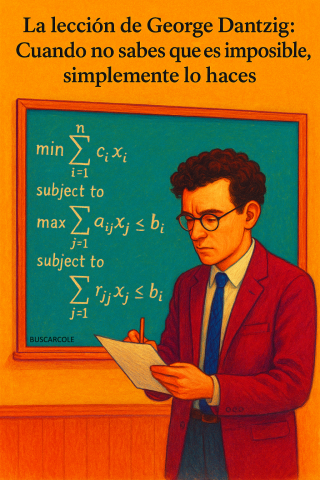
During a math class at Columbia University, a student arrived late and found two problems written on the blackboard. Believing they were homework, he quickly copied them down before the professor erased them.
That night, he set about solving them. They were extremely difficult, much more so than any other exercises he had seen before. Even so, he didn't give up. He spent entire days thinking about them, sleepless nights poring over textbooks and sheets of paper covered with notes.
Finally, he managed to solve one. He wrote four articles detailing his reasoning and solutions, convinced that he had accomplished a demanding academic task.
In the next class, he approached the professor with some discomfort and asked why they hadn't reviewed the homework. The professor looked at him in surprise and replied:
—“Homework? Those problems weren't homework. They were examples of open problems that no one has been able to solve so far.”
The student, bewildered, remained silent.
This student was George Dantzig (1914-2005), who would later become one of the most influential mathematicians of the 20th century. His work in linear programming would transform entire industries, from logistics to economics.
But the most powerful aspect of this story is not the mathematical achievement itself, but the lesson it contains:
Often, what limits us is not the difficulty of the problems, but our beliefs about them.
Dantzig achieved the unthinkable because he did not know it was impossible. His mind was not conditioned by the idea of failure. There was no fear, no mental blocks. There was only a sheet of paper with a problem to be solved.
How often do we give up before even trying something?
In the world of education, this story invites us to reflect on the power of expectations. What would happen if we stopped warning our students that something is “difficult”? What if, instead of telling them how complicated a path is, we gave them the tools, motivation, and confidence to walk it?
This story is not just an anecdote. It is a reminder: curiosity, effort, and perseverance are worth more than any label that says “impossible.”
Share this story. Someone may need to hear today that impossible... is just a word.