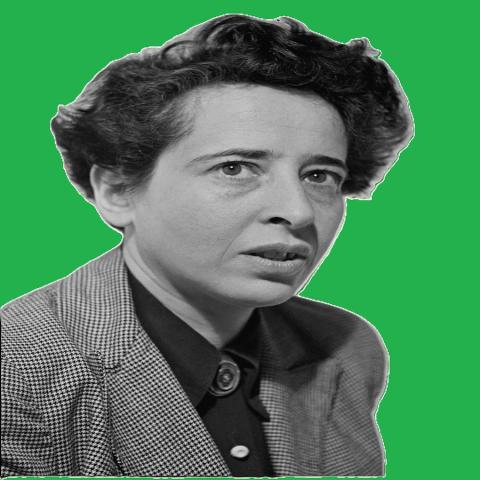
Hannah Arendt, one of the most influential political philosophers of the twentieth century, was deeply interested in the nature of human action and its impact on the world. Although she did not devote a specific treatise to “small actions,” her ideas on plurality, action and responsibility allow us to reflect on the meaning and power of our everyday actions.
The power of the everyday
Hanna Arendt argued that politics is not limited to major events or momentous decisions, but manifests itself in the small actions of everyday life. These actions, though seemingly insignificant, help to weave the fabric of social and political life.
The banality of evil: Arendt, in her study of the Adolf Eichmann trial, highlighted how ordinary people can commit heinous acts simply by following orders or going with the flow. This shows us that even the smallest actions can have devastating consequences if carried out in a context of injustice or totalitarianism.
Plurality and responsibility: the German philosopher emphasized the importance of human plurality. Each individual is unique and has the capacity to act in an original way. This plurality implies individual responsibility, since each of our actions contributes to shaping the world in which we live.
Small actions and public space
Public space, according to Arendt, is the place where people gather to discuss, debate and act together. The small actions we take in this space help to shape it and keep it alive.
Revealing action: through our actions, we reveal who we are and what values we stand for. Even the smallest actions can have a significant impact on how others perceive us and how we relate to them.
The importance of judgment: Arendt considered judgment to be a fundamental capacity for communal living. By judging the actions of others, we are acknowledging their humanity and engaging in a dialogue about what is good and what is bad.
To conclude...
Small actions, far from being trivial, are the raw material of political life. Each of us, through our daily choices, contributes to building a more just or more unjust world. By understanding the power of our actions, we can take greater responsibility for the world we live in.
In short, small actions, according to Arendt, are:
- Revealing: they show who we are.
- Responsible: they contribute to shaping the world.
- Polítical: they are part of the fabric of social and political life.
What do you think of this interpretation of small actions in Hannah Arendt's philosophy? Can you think of any examples of how small actions have had a big impact on your life or on society?