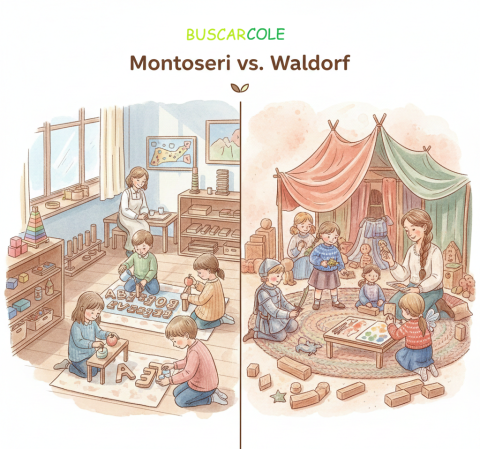
When searching for the perfect school, it is common to come across the terms Montessori and Waldorf. Both are “alternative teaching methods” with more than a century of history, both respect the child's pace, and both shy away from the traditional system of exams and memorization. However, although they share humanistic roots, their methods are very different.
At buscarcole.com, we help you break down these differences so you can find the one that best suits your family.
1. The approach: reality or imagination?
This is perhaps the most profound difference between the two approaches:
• Montessori: Focuses on “work” in the real world. Children use real utensils (glass cups, safe kitchen knives, brooms made to their size). The goal is autonomy and connection with physical reality.
• Waldorf: Focuses on imaginative play and fantasy, especially in early childhood. Imagination is believed to be the basis for future creative thinking. Toys are often simple and undefined in shape (such as cloth or pieces of wood) so that the child can decide what they represent.
2. The role of the teacher
• Montessori (The guide): The teacher acts as an observer. They prepare the environment and then withdraw to let the child choose their activity. Intervention is minimal so as not to interrupt the child's concentration.
• Waldorf (The Teacher): The teacher plays a more active and directive role. They act as a role model that the children imitate. In Waldorf schools, it is common for the same teacher to accompany the same group of students for several years (seven-year cycles), creating a very strong emotional bond.
3. Environment and materials
| Characteristic | Montessori | Waldorf |
| Aesthetics | Tidy, minimalist, and bright spaces. | Warm colors (pinks, peaches), natural and cozy materials. |
| Materials | Specific scientific materials designed for learning concepts (math, language). | Natural and artistic materials (wool, wax, watercolors, wood). |
| Technology | Gradual introduction, seen as a practical tool. | Completely avoided at early ages to protect sensory development. |
4. Learning
• Montessori: Learning is individualized. If a 4-year-old is interested in letters, they can start reading. If another prefers to focus on numbers, they are free to do so. There is no imposed group pace.
• Waldorf: Learning is more collective and follows a seasonal and rhythmic pace. Priority is given to the arts, manual skills, and movement. Reading and writing are usually introduced later (around age 6 or 7), with priority given to emotional maturation first.
Checklist: What to ask when visiting a Montessori or Waldorf school
Not all schools apply these teaching methods in the same way. To find out if the school is right for you, we suggest asking these questions during your visit:
If you visit a Montessori school:
1. Are the materials within the children's reach? (Observe whether the furniture allows the child to be 100% independent).
2. How are the ages mixed in the classrooms? (The ideal in Montessori is 3-year cycles: e.g., children aged 3 to 6 together).
3. How are mistakes handled? (In this teaching method, the materials are “self-correcting”; children must realize on their own if something is wrong without adult intervention).
4. How much freedom of movement do they have? (Ask if children can change activities or locations whenever they want).
If you visit a Waldorf school:
1. What is the daily and weekly schedule? (Waldorf relies heavily on repetition and rituals; ask how they structure the day).
2. How much time do they spend outdoors? (Contact with nature is a fundamental pillar, regardless of the weather).
3. How do they integrate the arts into academic subjects? (Ask how they teach, for example, math through drawing or movement).
4. What specific training do the teachers have? (The Waldorf teaching degree is a deep specialization and is key to the method).
Common questions for both:
• How is the transition to a traditional system? (It is vital to know how they support students if they need to switch to a school with an official curriculum in the future).
• What is the role of families in the school? (Both pedagogies tend to require a high level of commitment from parents in the school community).
Which one should you choose?
There is no right answer, only the right answer for each child:
• If you are looking for an environment where your child can develop independence, self-discipline, and logic, Montessori may be the right choice.
• If you prefer an environment that encourages creativity, the arts, and a strong sense of community, Waldorf could be the way to go.
At buscarcole.com, we know that reading about it is the first step, but nothing replaces a visit to the school. We invite you to use our search engine to filter schools by teaching method and make an appointment.
Leading schools in Spain
If you are looking for institutions with a proven track record or outstanding recognition, here are some of the most prestigious schools for each methodology.
Leading schools in Montessori education
Many of these centers are accredited by the AMI (Association Montessori Internationale) or appear in rankings of educational excellence:
• Montessori Palau (Girona): One of the most recognized centers in Spain. It stands out for its enormous facilities, its own farm, and an approach that covers ages 0 to 18.
• The English Montessori School - TEMS (Madrid): A benchmark in the capital that combines the Montessori method in the early years with the British curriculum.
• Imagine Montessori School (Valencia): A modern and sustainable school that has gained prominence for its international approach and B-Corp certification.
• Montessori British School (Murcia): Known for its international atmosphere and for offering the methodology at all educational stages, including boarding school.
• Akua (Barcelona): Located in Santa Coloma de Cervelló, it stands out for its focus on “talent pedagogy,” integrating the foundations of Montessori with personalized attention to each student's potential.
Highlights in Waldorf education
These centers are usually run by associations of families and teachers and are linked to the Association of Waldorf Educational Centers in Spain:
• Escuela Libre Micael (Las Rozas, Madrid): This is the first Waldorf school founded in Spain (1979) and offers the complete cycle up to high school.
• Escola Waldorf-Steiner El Til·ler (Bellaterra, Barcelona): Located in a privileged natural setting, it is one of the most established schools in Catalonia.
• Escuela Internacional Waldorf El Montgó (Jávea, Alicante): Highly valued by international families, it offers a bilingual education surrounded by nature.
• Escuela Waldorf de Aravaca (Madrid): A very active center in the community that stands out for its artistic approach and care for the emotional environment.
• Escuela Internacional Waldorf (Valencia): Located in Puig de Santa Maria, it is the benchmark for the method in the Valencian Community due to its long history.
Advice from buscarcole.com
Advice from buscarcole: Remember that many of these centers are private or international. In our search engine, you can also filter by proximity and educational stages to find the option that best suits your budget and location. Are you ready to take the next step?
Use our search engine at buscarcole.com to find Montessori and Waldorf centers near you, view their detailed profiles, and request information today.